Until recently, oil spill risk management systems relied heavily on approaches such as the NEBA (Net Environmental Benefit Analysis) tool, which primarily focused on economic feasibility when assessing the overall environmental impact. This methodology helped streamline risk assessment, reduce the cost of environmental services, and improve the efficiency of oil production. In many cases, NEBA-based decision-making favoured inaction over intervention, as the economic costs of remediation often outweighed the perceived benefits when compared to natural weathering over time. While this approach reduced the risk of secondary contamination from remediation procedures, it also increased the long-term uncertainty surrounding the fate of contaminated sites. In some instances, “doing nothing” was considered more effective — and even more environmentally sound — than “doing something”.
However, within the current framework of sustainable and resilient remediation, such a strategy is no longer acceptable. In our previous article, “Why ‘Out of Sight’ is No Longer ‘Out of Mind’ in Oil Waste Management” [1], we argued why the passive handling of oil waste is no longer a viable option.
One of the key reasons behind the global shift away from “postponing” the problem — whether through landfilling or long-term storage — lies in the significant climatic impacts these sites can have. On a regional scale, they disrupt local ecosystems’ thermal and hydrological regimes; on a global scale, they contribute to greenhouse gas emissions. Recent studies have shown that landfilling sites emit substantial amounts of greenhouse gases, and oil-contaminated soils are active sources of methane emissions.
To address these broader ecological impacts, modern decision-making processes increasingly incorporate evaluation tools that account for the multifaceted outcomes of remediation — including climate-related effects. One of the most promising tools is the growing use of Life Cycle Assessment (LCA) in risk management strategies.
Now, building on the latest LCA calculations based on ISO 14040/14044 standards, we take this conversation further. Our analysis of the Arvox SRT method confirms that the technology is not only CO₂-neutral — it can even achieve a CO₂-negative footprint.
We developed our remediation approach from the very beginning following that principle: in terms of carbon footprint Arvox SRT is designed as an emission-balancing system, capable of reducing emissions to zero or even achieving negative emissions.
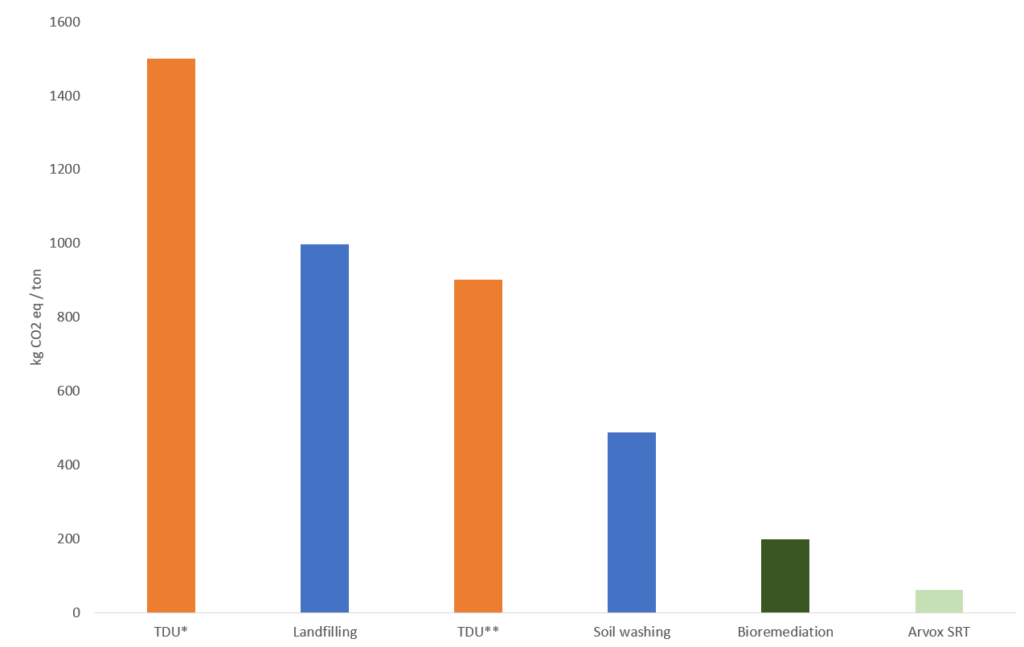
As a first step we carefully investigated all GHG impacts that can be associated with the Arvox SRT method and compared the resulting values with the conventional remediation approaches (see Figure 1 below). Arvox technology produces 61.35 kg CO2eq for 1 ton of the treated substrate that is 3 times less than bioremediation, more than 15 times less than landfilling and up to 25 times less compared to thermal desorption units (TDU). What is interesting is that the emissions from hydrocarbons mineralised to gaseous CO2 through the SRT oxidation procedure turned out to be insignificant compared to general input from main chemicals manufacturing processes and power supply. So the treatment process itself contributes very little in terms of GWP.
As a second step of our study we have reviewed all the possible CO2-sequestration pathways able to allow us to achieve zero-emission point for the technology after the finalisation of the Arvox SRT chemical process and complete soil ecosystem recovery. It has been found that there are two main pathways how to eliminate emissions available: passive (such as methanogenesis compensation and soil indigenous bacteria carbon fixation) which are inherent to our technology by default, and active (like fixation by grass plants and grass associated bacteria) with which Arvox technique can be easily followed if needed.
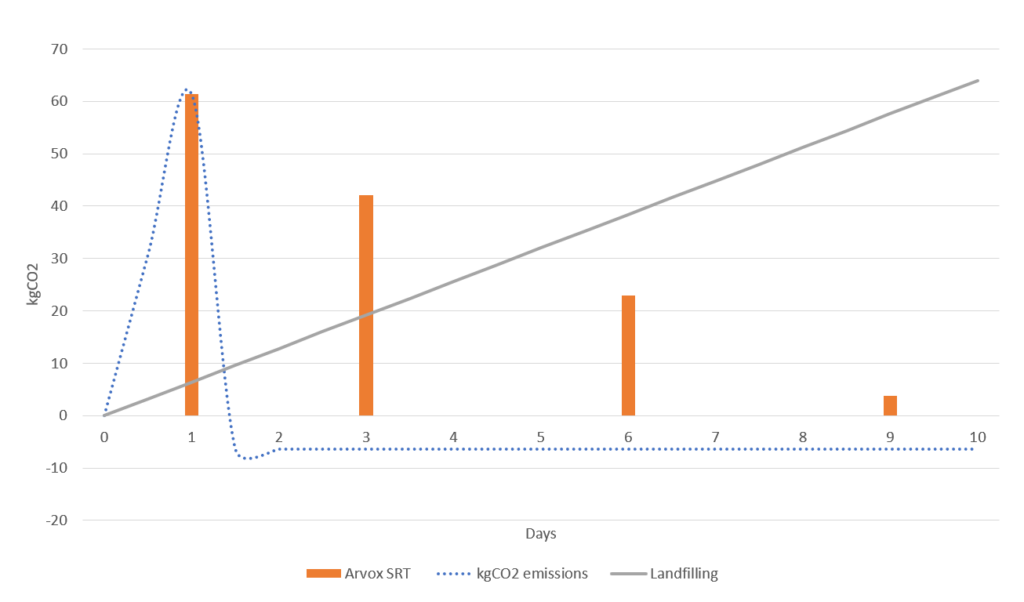
It is known that oil contaminated substrates (soils, OBMs, etc.) are recognised as sources of methane emissions due to the lack of oxygen in the bulk oily substrate, which fosters biological processes that produce methane. Methane is clearly one of the most active GHGs, where 1 kg is almost equivalent to 30 kg CO2eq. A fresh oil spill undergoing natural weathering releases significant amounts of methane before hydrocarbons degrade naturally. Previously we already reported that if an oil spill remains untreated for an extended period, it will generate substantial emissions. Due to our calculations based on literature data [4] contaminated soil emits 131.64mg CO2eq/m2 hourly. However, applying Arvox treatment will limit methane production at least to basic levels of uncontaminated soils, i.e. gives significant reduction of natural emissions from such sites (to 104.98mg CO2eq/m2). Therefore, compensation for a site 100*100m corresponds to 266.566g CO2eq/h that is equal to 6.398kg CO2eq per day, see Figure 2.
As a minor CO2 sequestration process dark fixation provides another opportunity for carbon capture. Nevertheless, this process is regular for all native soils from arctic permafrost to hot deserts [5]. The presence of dark fixation itself could be an indicator of a sustainable soil ecosystem as this process occurs in soil inevitably if only soil was not sterilised. We proved multiply times that Arvox SRT does not kill the native microflora, so dark fixation would passively occur after a short period of microbiome restoration that takes around 14 days after treatment. This process could belong to passive sequestration methods as operators should not stimulate any additional activities to apply.
Consequently, the CO₂ emissions generated by the Arvox process are quickly offset by the reduction in natural site emissions, allowing our technology to achieve a net-zero or even negative-emission impact compared to the site’s natural state. In 10 days treated substrate scattered on the 100*100m site will totally zero out GHG emissions from treatment procedure in comparison with non-treated substrate. Being a distinguished feature of Arvox SRT such compensation occurs just as a result of its application cutting the site emissions surplus.
Author:
Sergey Seryy, PhD – Head of Research and Development
References:
- https://www.linkedin.com/pulse/why-out-sight-longer-mind-oil-waste-management-6jzze/?trackingId=aQIFkQPxAU8M5mQ3RxH31g%3D%3D
- Guangji Hu, Jianbing Li, Guangming Zeng (2013), Recent development in the treatment of oily sludge from petroleum industry: A review, Journal of Hazardous Materials, Volume 261, Pages 470-490, ISSN 0304-3894, https://doi.org/10.1016/j.jhazmat.2013.07.069.
- Gitte Lemming, Michael Z. Hauschild, Julie Chambon, Philip J. Binning, Cécile Bulle, Manuele Margni, and Poul L. Bjerg (2010), Environmental Impacts of Remediation of a Trichloroethene-Contaminated Site: Life Cycle Assessment of Remediation Alternatives Environmental Science & Technology, 44 (23), 9163-9169 DOI: 10.1021/es102007s
- Yang, Juejie & Li, Guanghe & Qian, Yi & Zhang, Fang (2018), Increased soil methane emissions and methanogenesis in oil contaminated areas. Land Degradation & Development
- Lynn, T.M., Ge, T., Yuan, H., Wei, X., Wu, X., Xiao, K., Kumaresan, D., Yu, S.S., Wu, J., Whiteley, A.S., 2017. Soil carbon-fixation rates and associated bacterial diversity and abundance in three natural ecosystems. Microbial Ecology